The traditional enterprise data strategy is broken. For over a decade, organizations running massive core operations have operated under a silent, costly penalty: the ETL Tax.
To run a single analytics report, train a machine learning model, or ground an AI agent prompt, companies are forced to copy data out of core applications, transform it across brittle middleware layers, and paste it into a separate silo. By the time that data is ready, it is already stale.
The arrival of the Oracle AI Data Platform (AIDP) completely rewrites this playbook. By unifying data engineering, open-source lakehouse architectures, and autonomous AI governance, Oracle is shifting the industry away from data duplication toward a zero-copy, zero-ETL reality.
The Core Problem: The Architecture of Data Sprawl
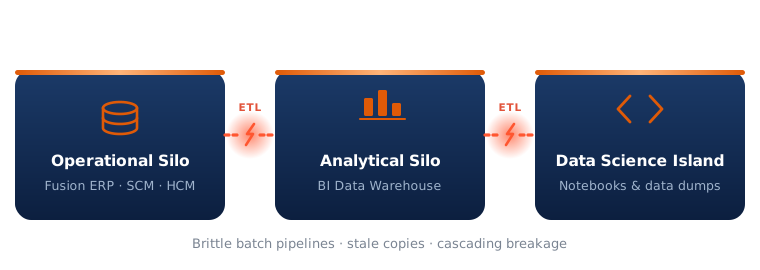
Before a unified data and AI engine existed, enterprise IT estates organically fractured into three isolated, disconnected execution zones:
- The Operational Silo — Core transactional engines (like Oracle Fusion ERP, SCM, and HCM) that lock away live accounting ledgers, supply chain inventories, and employee payroll profiles.
- The Analytical Silo — Separated data warehouses built by BI teams to run historical dashboards.
- The Data Science Island — Isolated code sandboxes or Jupyter Notebooks where ML teams manually analyze static data dumps.
The Structural Breakdown: Connecting these silos requires hundreds of complex, high-maintenance ETL batch pipelines. If a single column changes in an ERP table, downstream analytics break, and AI models begin hallucinating or failing entirely.
Enter Oracle AI Data Platform: The Zero-Copy Revolution
The Oracle AI Data Platform stops data sprawl by bringing the compute and the AI directly to where the data already lives. Instead of treating data engineering and artificial intelligence as two separate worlds, it structures them into a single, unified pipeline.
01Open Lakehouse Interoperability
The foundation of AIDP is a highly optimized, open-source lakehouse ecosystem. It natively supports industry-standard open table formats — specifically Apache Iceberg, Delta Lake, and Apache Hudi (leveraging Delta Uniform). This eliminates proprietary format lock-in, allowing data teams to run distributed processing directly over OCI Object Storage using managed Apache Spark engines.
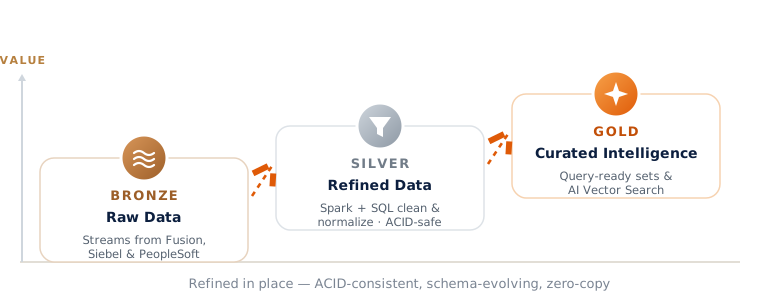
02The Medallion Data Lifecycle
Data inside the platform flows through a highly automated, three-step pipeline — refined in place, never copied out.
From Passive Insights to Agentic AI
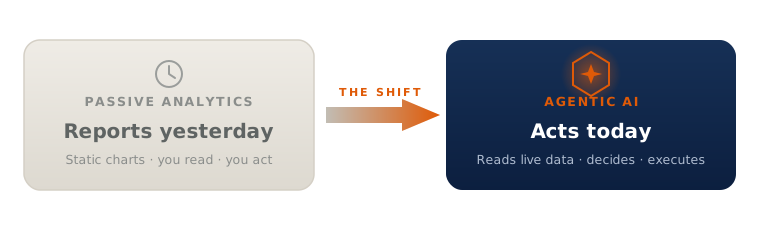
The critical architectural shift of the platform is the move from Passive Analytics to Agentic AI. Traditional data platforms excel at showing you what went wrong yesterday via a colorful chart. AIDP is designed to power Autonomous AI Agents that analyze current-state data and take corrective actions today.
Through the AI Data Platform Workbench, developers can leverage:
- Model Context Protocol (MCP) — Allows frontier LLMs (such as xAI Grok 4.3 or NVIDIA Nemotron 3 Ultra hosted on OCI) to securely reason through backend database layers.
- Native HTTP REST & Session Attributes — Enables agents to dynamically ingest context passed straight from web or APEX interfaces and execute automated actions back into enterprise systems.
Whether it is an AI agent detecting a receiving discrepancy in an SCM module and autonomously drafting an invoice dispute, or an HR compliance agent scanning global legal PDFs to cross-reference localized employee compliance rules in HCM, the workflow remains completely zero-copy.
Unified Governance via the Master Catalog
Building enterprise-grade AI requires bulletproof security. The platform enforces strict control across the entire data lifecycle via a centralized Master Catalog:
- End-to-End Data Lineage — Full visibility into exactly how a raw operational data point transformed into an AI feature or triggered an autonomous agent’s output.
- Dynamic Data Masking & RBAC — Ensures that when an AI model or RAG application queries data, it strictly respects the end-user’s specific clearance levels — preventing sensitive financial or payroll leaks.
- Enterprise Credential Store — Eliminates hardcoded tokens, API keys, or database passwords from PySpark notebooks and pipeline definitions by referencing secure OCI Vault assets.
Architecture Blueprint: Old vs. New
| Capability | The Traditional Way | Oracle AI Data Platform |
|---|---|---|
| Data Architecture | Disconnected transactional, analytical, and ML silos. | Unified Autonomous AI Lakehouse environment. |
| Data Pipelines | Heavy, brittle, batch-based ETL data movement. | Zero-Copy virtualization and native ingestion connectors. |
| Storage Standards | Siloed, proprietary database tables and data swamps. | Open table formats via Apache Iceberg & Delta Lake. |
| AI Implementation | Exporting static data dumps to external ML layers. | Natively embedded Vector Search, RAG, and Agentic MCP. |
| DevOps & Lifecycle | Fragmented scripts, manual tracking, hidden code tokens. | Workbench IDE with native Git, Bundle CI/CD, and Credential Stores. |
Frequently Asked Questions
01What does "Zero-ETL" actually mean when connecting to Oracle Fusion Cloud?
Traditionally, getting data out of Fusion ERP, SCM, or HCM for AI processing required writing custom extraction scripts to pull, format, and load data into a separate repository. In the Oracle AI Data Platform, Zero-ETL means you connect directly via an External Catalog. The platform reads the data structure (metadata) and streams or queries the live data in-place — without requiring data engineers to build or maintain complex data-moving pipelines.
02Does a "Zero-Copy" architecture impact the performance of our live production ERP or SCM systems?
No. Oracle AI Data Platform leverages intelligent data virtualization and metadata federation. When an AI agent or a Spark processing script requests data, it uses optimized query pushdowns and isolated analytical mirrors. This ensures that massive AI workloads or vector searches run smoothly without consuming the transactional compute resources needed by your day-to-day business operations.
03How does the platform handle security if AI models are reading live Fusion HCM data?
Security is managed centrally through the platform’s Master Catalog. It natively enforces strict Role-Based Access Control (RBAC), end-user row/column-level filtering, and dynamic data masking. This means that even if an AI model or autonomous agent has the capability to process data, it will never surface or summarize sensitive information (such as payroll details in HCM or corporate profit margins in ERP) to a user who does not have explicit security clearance to see it.
04What are Apache Iceberg and Delta Lake, and why do they matter for this platform?
These are open-source, high-performance table formats. In older architectures, data lakes often turned into unorganized "data swamps" where files were hard to track. Apache Iceberg and Delta Lake bring the reliability, speed, and structure of a traditional database to massive cloud storage. By using these open standards, Oracle AIDP eliminates proprietary data lock-in, allowing your data to remain fully interoperable across different multi-cloud tools and engines.
05Can we use our existing Oracle Integration Cloud (OIC) alongside the AI Data Platform?
Absolutely — they serve complementary roles. Oracle Integration Cloud (OIC) remains your primary engine for real-time, process-driven application integrations (like instantly syncing an order from a web store into Fusion SCM). The AI Data Platform picks up where traditional integration ends — aggregating massive amounts of structured and unstructured data, running heavy data-engineering jobs via Spark, and powering autonomous AI agents that require deep business reasoning across multiple modules.
The New Standard for Enterprise IT
The Oracle AI Data Platform represents a fundamental rethink of enterprise architecture. By wiping out the infrastructure complexity, high egress fees, and security liabilities of traditional ETL pipelines, it provides a direct, secure line from raw operations to autonomous execution. For organizations running on Oracle ecosystems, it is no longer a question of if you should adopt a unified data lakehouse architecture, but how fast you can transition to gain a competitive, agentic advantage.
Let’s look at your current Oracle environment and map out the cleanest path to a unified, agentic data architecture.